Learning to drive comes with legal responsibility the moment a vehicle enters public traffic. During a road test, a permit holder operates a vehicle on active roads under state supervision.
The car must meet all legal requirements before the examiner allows it to move. That includes current registration, working safety equipment, and active liability insurance that meets state minimum limits.
Many people view the driving test as a routine evaluation of basic skills. In reality, it involves operating a vehicle in active public traffic under full legal responsibility.
During the exam, a permit holder drives on real roads among other vehicles, pedestrians, and unpredictable conditions. The legal and financial risks are the same as any other trip on public streets.
Many test failures have nothing to do with driving ability. They happen before the engine even starts. Insurance is one of the most common reasons a test is canceled on the spot.
This happens because people assume coverage starts after passing, or that the test location provides protection.
Driving laws exist to reduce harm, not confusion. Insurance is required wherever a car is driven legally. A driving test is no exception. Understanding coverage requirements beforehand saves time, money, and stress.
Rules are strict because the stakes are high. A test car without coverage exposes everyone involved to financial and legal damage. Governments do not bend on this.
This guide breaks the topic down clearly, without guesswork, so you know exactly what is required and why it matters.
Do You Need to Be Insured to Take a Driving Test?
A driving test requires a vehicle with active liability insurance that meets state minimum requirements. Coverage may belong to the learner, the vehicle owner, or a licensed driving school, and valid proof must be presented before the test begins.
A driving test takes place on public roads. Because the vehicle is driven in live traffic, the law treats the test the same as any other driving activity. The car must be legal at the moment the test starts.
This includes the following:
- Current registration
- Working safety equipment
- Active liability insurance that meets state standards
Insurance does not need to be in the learner’s name. Many first-time drivers do not yet have their own policy. Using a parent’s or guardian’s vehicle is common. In these situations, the insurance policy attached to the car usually extends coverage to permitted drivers, including learners taking a road test.
The key requirement is clear:
- The policy is active
- The policy allows another driver to operate the vehicle
If the vehicle belongs to another private owner, such as a friend or relative, the same rules apply. The owner’s insurance must be valid on test day. The policy must also allow additional drivers. Some policies limit who may drive the car.
The following conditions must be confirmed in advance:
- The insurance is valid on test day
- The policy allows additional drivers
- The learner is not excluded under the policy
If the policy excludes other drivers, the vehicle cannot be used for the test. Checking this detail ahead of time prevents cancellations.
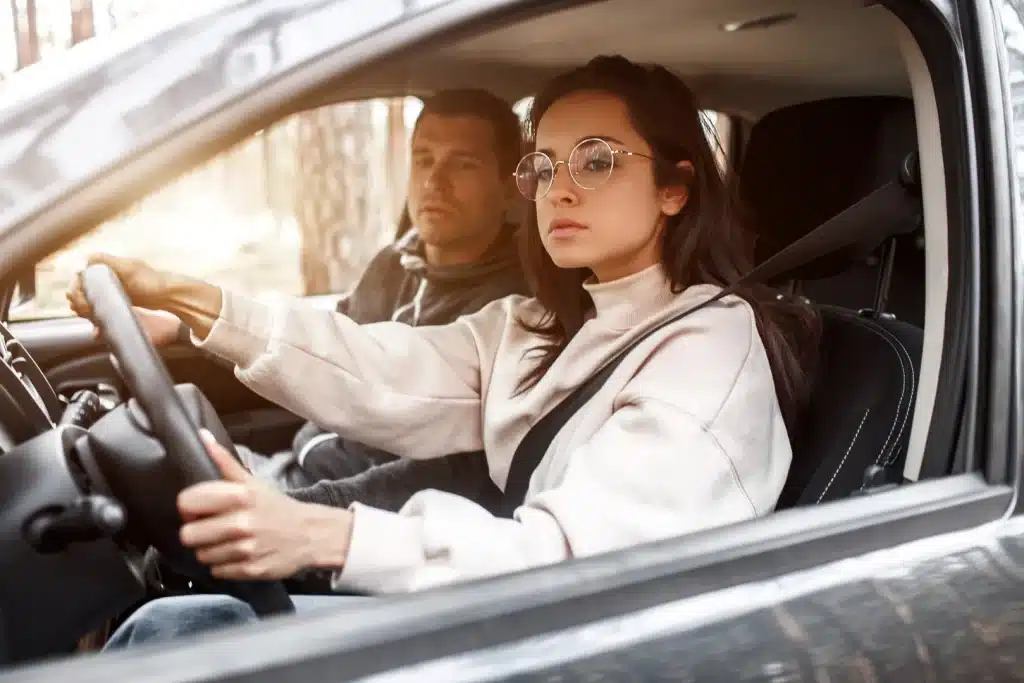
Vehicles provided by driving schools are covered under commercial insurance policies designed for instruction and testing. These policies specifically include student drivers during lessons and official road tests.
When a driving school vehicle is used, the following applies:
- The learner does not need personal insurance
- Proof of coverage is provided by the school as part of the testing arrangement
Examiners verify insurance before the test begins. This check occurs before the learner enters the driver’s seat. Proof may be a physical insurance card or a digital copy, depending on state rules.
The policy must meet all of the following:
- Active status
- Unexpired coverage
- Matching vehicle information
Missing or invalid proof results in immediate cancellation of the test.
Driving ability does not override legal requirements. Even a fully prepared driver cannot proceed without valid insurance. Examiners are required to enforce this rule strictly and do not have discretion to continue the test without proof of coverage.
If a test is canceled due to insurance issues, fees are typically not refunded. A new appointment must be scheduled, which may involve long wait times.
To avoid delays, confirm the following before test day:
- Insurance is active
- The policy allows the test driver
- Acceptable proof is available
Confirming insurance status in advance and bringing valid proof on test day prevents unnecessary delays.
Insurance exists to assign financial responsibility in case of damage or injury. During a driving test, the risk is real. Active coverage ensures that responsibility is clearly defined before a vehicle enters public traffic.
That clarity matters, because the source of that coverage depends on who owns and insures the vehicle used for the test.
Who Provides Insurance for the Driving Test Car
Insurance coverage for a driving test is provided by the owner of the vehicle used. A learner’s own car uses their policy, a borrowed car uses the owner’s policy, and a driving school car is covered by the school, with valid proof required on test day.
Insurance responsibility is tied to the vehicle, not to the driving test itself. The law requires every vehicle on public roads to carry active liability insurance that meets state minimum limits.
A driving test does not change this requirement. The same rules apply whether the car is driven by a licensed driver, a learner, or a test candidate.
When the Learner Owns the Vehicle
When the learner owns the vehicle, their insurance policy must be active on the day of the test. The policy must cover the specific vehicle being used and meet the minimum liability limits required by the state.
The following must be confirmed:
- The policy is active on the test date
- The specific vehicle is listed on the policy
- The coverage meets state minimum liability limits
- Proof of insurance matches the vehicle’s registration details
If the policy is expired, suspended, or does not list the vehicle correctly, the test cannot proceed.
When the Vehicle Belongs to a Parent or Private Owner
If the learner uses a vehicle owned by a parent, guardian, or another private individual, the owner’s insurance policy provides coverage. Most standard auto insurance policies extend coverage to permitted drivers, including learners taking a road test.
The key requirement is clear:
- The policy allows additional drivers
- The learner is permitted under the policy
Some policies restrict coverage to named drivers only. If the learner is not permitted under the policy, the vehicle cannot be used for the test.
Using a friend’s or relative’s vehicle follows the same rules. The owner’s insurance must be active, valid, and applicable to the test driver. The learner should confirm in advance that the policy allows other drivers. This avoids last-minute cancellations caused by policy restrictions that are discovered too late.
When Using a Driving School Vehicle
Driving school vehicles are insured under commercial policies designed specifically for instruction and testing. These policies include coverage for student drivers during lessons and official road tests.
When a driving school vehicle is used, the following applies:
- The learner does not need personal insurance
- Proof of coverage is provided by the school
- Documentation may be presented directly or by the instructor at the test
The California Department of Motor Vehicles confirms that any vehicle used for a driving test must be insured and compliant with state law.
Insurance Verification Before the Driving Test
Examiners verify insurance before the test begins. This verification occurs before the learner enters the driver’s seat.
Acceptable proof may include:
- A physical insurance card
- A digital version, depending on state rules
The insurance must be active on the test date and must correspond to the vehicle being used.
Examiners do not verify who pays the insurance premium. Payment responsibility is irrelevant. Their role is limited to confirming that valid coverage exists and that the vehicle is legally insured at the time of the test. If proof cannot be shown or if the policy is invalid, the test is canceled immediately.
Insurance exists to assign financial responsibility if damage or injury occurs. During a driving test, the risk is real. Clear insurance coverage ensures that responsibility is established before the vehicle enters public traffic, protecting the learner, the examiner, and the public.
Insurance by Vehicle Ownership
The following breakdown shows how insurance coverage changes based on who owns the vehicle:
| Vehicle Owner | Insurance Source | Accepted Proof |
| Learner | Learner policy | Insurance card |
| Parent | Parent policy | Insurance card |
| Friend | Friend policy | Insurance card |
| Driving school | School policy | School proof |
The table above clarifies how insurance coverage changes based on vehicle ownership and what proof is required in each case. One option that removes ownership and policy questions altogether is using a driving school vehicle, which is covered under dedicated instructional insurance.
Using a Driving School Car for Your Driving Test
Using a driving school vehicle for a driving test provides insurance through the school’s commercial policy. The vehicle, coverage, and required proof are supplied by the school, and insurance remains active for the entire test without personal paperwork.
Driving schools offer vehicles that are specifically prepared for instruction and official driving tests. These vehicles are insured under commercial auto insurance policies designed for student use.
The coverage applies during practice lessons and continues without interruption during the official road test. This removes the need for the learner to arrange or verify personal insurance.
Commercial driving school insurance differs from private auto insurance. It is structured to cover multiple student drivers, instructors, and exam situations.
The policy is attached to the vehicle and explicitly allows learners to operate the car during testing. This makes the vehicle legally compliant for use on public roads during the exam.
What a Road Test Package Usually Includes
Most driving schools require learners to book a road test package. The exact structure varies by school, but insurance coverage is always included.
A typical package may include:
- Use of the school vehicle
- Insurance coverage
- Coordination with an instructor
- A short practice session before the test
Some packages also include a short practice session before the test to help the learner become familiar with the car.
Insurance Handling on Driving Test Day
When a driving school vehicle is used, the learner does not need to provide personal insurance. Proof of coverage is handled by the school.
On test day:
- The instructor may bring the required documentation to the test location
- The examiner verifies the school’s insurance before the test begins
- The process mirrors the verification of a privately owned vehicle
Coverage provided by driving schools remains active for the entire test. This includes the time spent driving on public roads, maneuvering in traffic, and completing all required test elements.
The learner is covered for liability during the full duration of the exam. This ensures legal compliance from start to finish.
Reduced Risk of Cancellation
Using a driving school vehicle also reduces the risk of test cancellation. Personal vehicles are often rejected for issues such as missing paperwork, expired insurance, or policy restrictions on additional drivers.
Driving school vehicles are maintained to meet testing requirements.
This lowers the chance of problems such as:
- Missing documentation
- Expired insurance
- Policy restrictions
- Mechanical or safety issues
Driving school vehicles are also regularly inspected. Schools typically ensure that lights, signals, brakes, mirrors, and tires meet testing standards. This prevents cancellations due to mechanical or safety issues that sometimes affect personal vehicles.
Comfort and Familiarity
Another advantage is consistency. Learners who have practiced in the same vehicle may feel more comfortable during the test.
The following factors are already familiar:
- Controls
- Visibility
- Handling
This can reduce stress and help the learner focus on driving performance rather than adapting to an unfamiliar car.
Cost Consideration
While using a driving school vehicle usually costs more than borrowing a private car, the added cost covers insurance, vehicle readiness, and administrative handling.
For many learners, this tradeoff is worthwhile to avoid paperwork errors and delays.
This option is especially useful for learners without access to a properly insured private vehicle or for those who want a straightforward, low-risk testing experience.
Regardless of the option chosen, insurance must be in place before test day, because arriving without it has immediate consequences.
Driving Test Consequences of No Insurance
Arriving for a driving test without valid insurance results in immediate cancellation. The examiner cannot begin the test without proof of active coverage, the appointment ends on the spot, and test fees are usually forfeited with rebooking required.
Arriving without insurance stops the driving test before it begins. Examiners are required to verify that the vehicle used for the test is legally insured.
This check happens before the learner enters the driver’s seat. If valid proof of insurance cannot be presented, the test does not proceed under any circumstance.
No Exceptions to the Rule
There are no exceptions to this rule. Examiners do not have discretion to delay the test, allow temporary proof, or proceed based on verbal confirmation.
Insurance verification is a mandatory step tied directly to road safety and legal responsibility. Without coverage, the vehicle cannot legally operate on public roads, even for a test.
What Counts as Invalid Insurance
Proof of insurance must be valid and current.
The following issues all lead to immediate cancellation:
- Expired policies
- Suspended coverage
- Mismatched vehicle information
- Missing documents
The appointment is canceled immediately. This applies even if the learner is fully prepared and arrives on time.
Financial Consequences
When a test is canceled due to lack of insurance, test fees are typically not refunded. Most licensing agencies treat this as a failure to meet eligibility requirements rather than an examiner error.
The learner must:
- Schedule a new appointment
- Pay any required fees again
Rebooking a driving test can take time. In many areas, appointment availability is limited. Delays of several weeks are common, especially during peak seasons.
This can disrupt:
- Personal schedules
- Employment plans
- Licensing deadlines
All of this stems from a paperwork issue rather than driving ability.
Legal Consequences Beyond the Test
Driving without insurance carries legal consequences beyond the canceled test. As stated by the Washington Department of Licensing, “It’s illegal to drive a car in Washington without liability insurance or another way to assume financial responsibility for damages.” Drivers who fail to meet this requirement face fines and penalties.
Because a driving test takes place in real traffic conditions, the same risks exist as with any other trip.
Insurance ensures that responsibility is clearly defined if an incident occurs. This protection applies to:
- The learner
- The examiner
- Other drivers
- Pedestrians
Each of these parties is exposed to real risk during a driving test. Active insurance ensures that financial responsibility is clearly established before the vehicle enters public traffic.
Common Incorrect Assumptions
Some learners assume that short distance or low speed reduces the need for insurance. This assumption is incorrect. Distance and duration do not affect legal requirements. The moment a vehicle enters public traffic, insurance rules apply fully.
Others believe that a learner permit replaces insurance. A permit authorizes practice under specific conditions. It does not provide financial responsibility coverage. Insurance remains a separate and mandatory requirement.
How to Avoid Cancellation
Avoiding cancellation is simple. Confirm your insurance several days before the test.
Preparation should include:
- Confirming the policy is active
- Printing proof or saving a digital copy according to local rules
- Checking that the policy covers the specific vehicle
- Confirming the learner is permitted to drive under the policy
Arriving prepared with valid insurance ensures the test focuses on driving performance, not administrative failure. That preparation must also account for state-specific rules, since each state sets its own requirements for how insurance proof is presented and verified.
State Differences in Driving Test Insurance Proof
State rules control insurance proof for driving tests. California and Texas accept digital cards, New York requires strict proof of financial responsibility, and some states still require printed cards or policies that allow the test driver.
Insurance requirements exist everywhere, but proof rules are set at the state level. This means the way insurance must be presented at a driving test can differ depending on where the test takes place. These differences affect format, documentation details, and driver eligibility under the policy.

States That Accept Digital Proof
In some locations, digital proof is accepted without issue.
- California allows both digital and printed insurance cards for driving tests. The proof must clearly show active coverage, policy dates, and vehicle details. If the information is incomplete or unreadable on a mobile device, the test can still be canceled.
- Texas also accepts digital proof of insurance. Drivers may present an electronic insurance card on a phone or tablet. However, the device must be accessible at the time of inspection. A dead battery or inability to open the document is treated the same as missing proof.
Even in states that allow electronic proof, accessibility and clarity of the document are required at the time of inspection.
States With Stricter Documentation Rules
Other states apply stricter standards.
- New York, proof of financial responsibility is required for every road test vehicle. The insurance must match the vehicle used, and discrepancies result in immediate cancellation.
- Florida requires the vehicle itself to be insured, regardless of who is driving. Proof must show active coverage tied directly to the car being used for the test.
- Illinois allows electronic proof but requires that the policy meet minimum liability limits and remain active through the test date. Temporary or expired proof is not accepted, even if coverage was active earlier.
These stricter standards focus heavily on policy accuracy and vehicle matching.
Policy Restrictions That Affect Test Drivers
Some states require the insurance policy to explicitly allow the test driver. This often affects vehicles with named-driver-only policies.
- If the learner is not permitted under the policy, the vehicle cannot be used for the test, even if the owner is present.
This requirement often causes last-minute cancellations when policy restrictions are overlooked.
Printed Proof and Temporary Insurance Variations
Printed proof is still required in a few states or in specific testing locations.
- In these cases, digital proof may not be accepted.
- Some states accept insurance binders issued by insurers.
- Others require a standard insurance card.
This is especially relevant for newly insured vehicles or recent policy changes.
Rental and Leased Vehicle Restrictions
Rental and leased vehicles are also treated differently.
- Some states restrict their use for driving tests unless the rental agreement and insurance explicitly allow it.
- Other states prohibit rental vehicles entirely for testing.
These restrictions vary and must be confirmed before scheduling the test.
Because of these differences, relying on general advice creates risk. Instructor guidance, online forums, or outdated blog posts may not reflect current state rules. Even rules within the same state can change over time.
The only reliable source for insurance proof requirements is the official motor vehicle department website for the state where the test is scheduled.
Verifying these rules ahead of time prevents cancellations and ensures the test focuses on driving ability rather than documentation errors. Most remaining issues come from common insurance myths that mislead learners and cause preventable test failures.
Insurance Myths That Cancel Driving Tests
Driving tests are often canceled due to insurance myths, including believing the test center provides coverage, a learner’s permit replaces insurance, or short routes change requirements. Insurance is required whenever a vehicle is driven legally.
Many driving test failures happen before the vehicle moves. These failures are caused by incorrect assumptions about insurance, not driving ability. Learners often arrive prepared to drive but unprepared on paperwork, which leads to immediate cancellation.
Myth: The Test Center Provides Insurance
One common myth is that the test center provides insurance. Test centers do not insure vehicles or drivers. Their role is limited to administering the exam.
Insurance must already be in place through:
- The vehicle owner
- A driving school
Without proof, the test ends before it begins.
Myth: A Learner’s Permit Replaces Insurance
Another frequent mistake is assuming a learner’s permit replaces insurance. A permit only allows someone to practice driving under certain conditions. It does not provide financial responsibility coverage.
Insurance and permits serve different legal purposes, and both are required.
Myth: Short or Slow Routes Do Not Require Insurance
Some learners believe insurance is unnecessary because the test route is short or slow. Distance and speed do not change the law.
The rule applies in every case:
- The moment a vehicle enters a public road, insurance requirements apply fully
- This includes even a brief test drive
Legal requirements are not reduced based on route length or traffic conditions.
Myth: Borrowed Vehicle Means Automatic Coverage
Borrowed vehicles cause confusion as well. Permission to use a car does not guarantee coverage.
Insurance only applies if:
- The policy allows additional drivers
- The learner is not restricted under the policy
Named-driver-only policies often block test approval, even when the owner is present.
Myth: Verbal Confirmation Is Enough
Verbal confirmation is another myth. Telling the examiner the car is insured is not enough.
Only the following is accepted:
- Documented proof of active coverage
Without it, the test is canceled immediately.
Myth: Digital Proof Always Works
Digital insurance cards also create problems. Some assume digital proof is always accepted.
In states that allow it:
- The document must be readable
- The document must be accessible
- A dead phone or loading issue counts as missing proof
Technical problems are treated the same as not having proof at all.
These myths persist because learners rely on advice from friends or outdated sources. The law is clear and enforced consistently. Insurance is required whenever a car is driven legally, including during a driving test. Preparation means you reject myths and ensure your coverage in advance.
Conclusion
A driving test requires a properly insured vehicle with active liability coverage that meets state minimums. The policy may belong to the driver, the vehicle owner, or a driving school, but valid proof must be presented before the test begins.
Insurance is not optional and is not provided by the test center. Proper preparation means confirming coverage in advance, verifying the policy allows the test driver, and bringing acceptable proof on test day. Missing or invalid insurance results in automatic cancellation.
Insurance rules exist to assign financial responsibility if damage or injury occurs. During a driving test, the risk is real because the vehicle operates on active public roads alongside other drivers and pedestrians. Active coverage ensures legal accountability is already in place before the examiner allows the vehicle onto public roads.
Most canceled tests caused by insurance issues are preventable. Checking policy status, proof format, and state-specific rules days before the appointment avoids delays, added fees, and rescheduling.
When insurance requirements are handled correctly, the test focuses solely on driving ability rather than avoidable administrative failure.