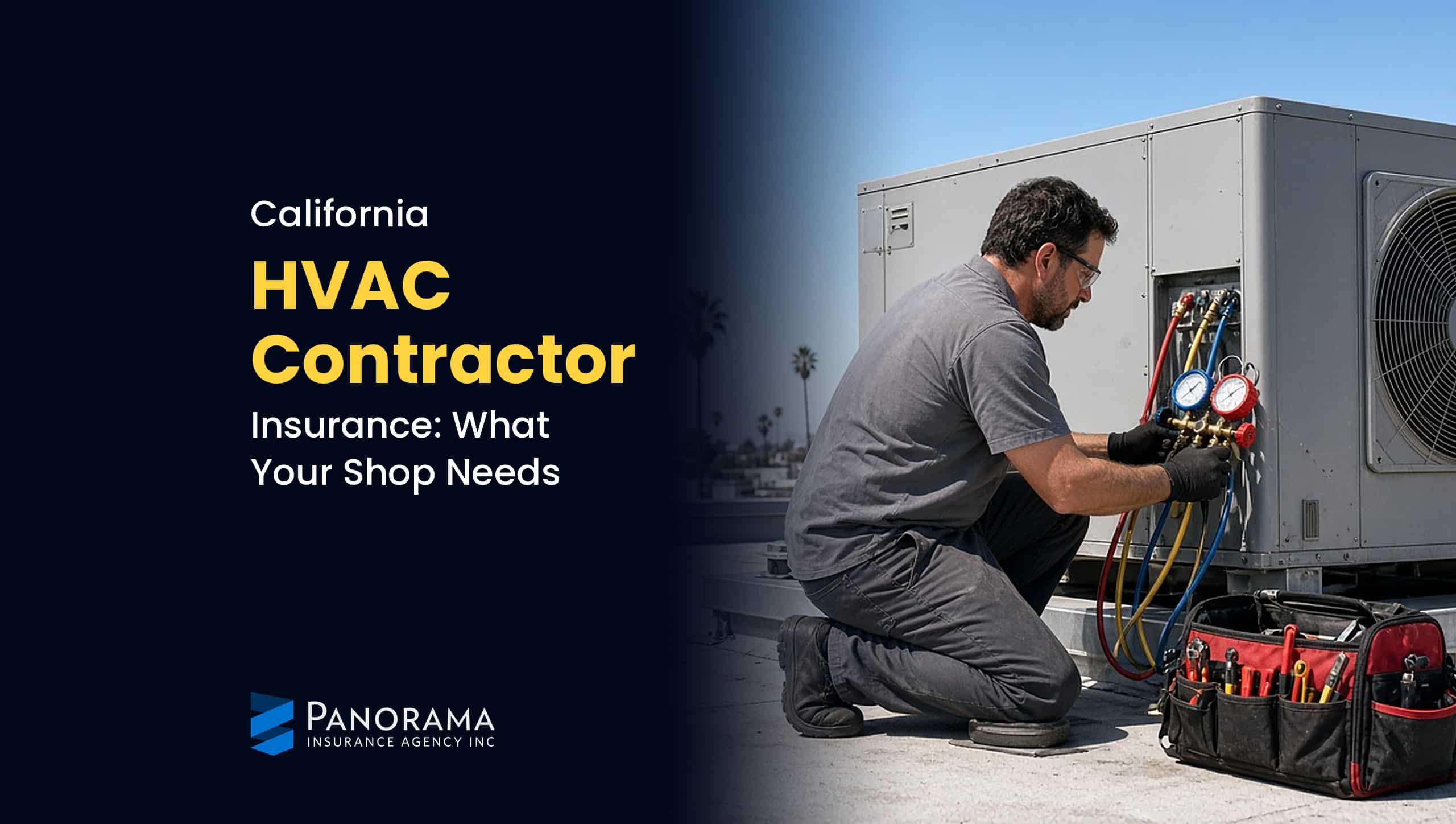
Contractor insurance in California usually means three things: general liability, workers’ comp, and a license bond. CSLB requires a $25,000 bond for every active license. It requires workers’ comp if you have employees, or if you’re in certain trades. General liability is required only for LLCs, but most clients and general contractors ask for it anyway.
Panorama Insurance Agency has worked with Los Angeles contractors from our Northridge office since 1973. This guide covers what the state requires, what clients usually ask for, and what to check before you buy, in plain English.
What insurance does a contractor need in California?
| Coverage | Required by CSLB? | Who usually asks for it |
|---|---|---|
| Contractor license bond ($25,000) | Yes, for every active license | CSLB |
| Workers’ compensation | Yes if you have employees; yes for C-8, C-20, C-22, C-39, C-61/D-49 even with none; all licensees from January 1, 2028 under current law | CSLB, the state, GCs |
| General liability (GL) | Only for LLCs | Commercial property owners, GCs |
| Commercial auto | Not by CSLB | GCs and commercial clients |
| Tools and equipment | No | Your own risk |
| Umbrella or excess | No | GCs and owners who want higher limits |
Does California require contractors to carry general liability?
Not most contractors. The CSLB Law Book says license law doesn’t require general liability unless your business is a limited liability company (LLC).
- An LLC with five or fewer people on its personnel of record must carry liability insurance with at least a $1 million aggregate limit.
- Each additional person adds $100,000, up to $5 million total.
Even when it isn’t required, you’ll likely need it. CSLB notes that commercial property owners routinely require it, and many general contractors ask for it too. On home improvement jobs, you must tell the homeowner in writing whether you carry general liability. If you do, you give them the insurer’s name and phone number so they can check. “This contractor does not carry commercial general liability insurance” is not a sentence that wins bids.
What does general liability cover?
General liability protects your business when your work hurts someone or damages their property. Think of a ladder that falls on a homeowner’s car, or a leak after you finish a bathroom remodel. It can pay for covered damages and your legal defense. It generally doesn’t pay to redo your own faulty work.
We’ve written more here: General Liability Insurance for Contractors in California.
Do contractors need workers’ comp in California?
Workers’ compensation pays for medical care and lost wages when an employee gets hurt on the job. If you have employees in California, even part-time, you need it.
The CSLB rules have a few twists:
- Every active license must have either a workers’ comp certificate on file with CSLB or a signed exemption saying you have no employees.
- Some trades can’t claim the exemption. C-8 Concrete, C-20 HVAC, C-22 Asbestos Abatement, C-39 Roofing, and C-61/D-49 Tree Service contractors must carry workers’ comp even with no employees.
- Coverage must be continuous. CSLB says a lapse will result in your license being suspended.
What changes in 2028?
Under current law (SB 1455), all licensed contractors must carry workers’ comp, regardless of employees, starting January 1, 2028. That date was pushed back from January 1, 2026. If you work solo today on an exemption, now is a good time to talk about what 2028 means for your budget.
For more, see Workers’ Compensation Insurance for Small Businesses in California.
How much is a California contractor license bond?
| Bond | Amount | Who needs it |
|---|---|---|
| Contractor’s bond | $25,000 (or a cashier’s check) | Every active license |
| Bond of Qualifying Individual | $25,000 | When a Responsible Managing Employee (RME) qualifies the license, or a Responsible Managing Officer who owns less than 10% of the company |
The contractor’s bond went up from $15,000 to $25,000 on January 1, 2023.
Is a license bond the same as insurance?
No. A contractor license bond is not insurance for you. It’s protection for your customers and workers. A bond claim can be filed if a contractor breaks license law, causes certain damage, or doesn’t pay workers. The bond pays the claimant. Then the surety will usually look to you to pay it back. That’s a big reason a bond doesn’t replace GL.
Panorama places contractor license bonds, so you can get your bond and your insurance in one place.
What other coverage should contractors ask about?
Depending on your work, you may also want to ask about:
- Commercial auto for trucks and vans used for the business. Your personal auto policy may not cover business use. See commercial auto insurance in California.
- Tools and equipment coverage for gear in your truck or on the job site.
- Umbrella or excess liability if a client or GC asks for higher limits than your GL carries.
We’ll tell you honestly which of these fit your trade and which you can skip.
What do general contractors ask subs for?
When you work as a sub, the GC will likely ask for your certificate of insurance before you start. Many will also ask to be named as an additional insured on your GL policy. Some ask for a waiver of subrogation on your workers’ comp or GL. Read the contract before you sign, then send it to us so we can see whether your policy can meet it. It’s much easier to fix a gap before the job starts.
What if you hire subcontractors?
Ask for their certificates of insurance before they start, and keep copies. If a sub doesn’t carry its own workers’ comp or GL, your insurer may count that sub’s payroll or work when it audits your policy. That can mean a surprise bill at the end of the year.
What to check before you buy
- Limits. Do your GL limits meet what your clients and GCs require? Ask for their contract language before you buy.
- Additional insured. Can you add a GC or property owner as an additional insured when they ask?
- Exclusions. Some GL policies exclude certain work, like roofing, residential tract work, or work above a certain height. Make sure your actual work is covered.
- Classification. Your workers’ comp class codes should match the work your crew really does.
- Payroll estimate. Workers’ comp is usually based on payroll. A low guess now can mean a big audit bill later.
- Certificates. How fast can you get a certificate of insurance when a GC needs one tomorrow morning?
What should you do when there’s a claim?
- For an injured worker, get them care first, then report the injury.
- Call us or your insurer right away.
- Don’t promise to pay for damage on the spot.
- Take photos, write down what happened, and get names of witnesses.
Fast reporting makes for a smoother claim.
FAQ
Does California require contractors to have general liability insurance?
Not for most contractors. The CSLB Law Book says license law requires it only for LLCs. An LLC needs at least a $1 million aggregate limit for five or fewer people on its personnel of record, plus $100,000 per additional person, up to $5 million. Clients and general contractors often require it anyway.
I have no employees. Do I need workers’ comp?
It depends on your trade. C-8 Concrete, C-20 HVAC, C-22 Asbestos Abatement, C-39 Roofing, and C-61/D-49 Tree Service contractors need it regardless. Other licensees with no employees can file a CSLB exemption for now. Under current law, all licensees need coverage starting January 1, 2028.
Is it better to be bonded or insured?
You need both. The $25,000 bond is required for every active California license, and it protects your customers and workers. If the surety pays a claim, it will usually seek repayment from you. Insurance protects your business. General liability and workers’ comp pay covered claims so you aren’t paying them yourself.
How much is the contractor license bond in California?
The contractor’s bond is $25,000, up from $15,000 since January 1, 2023. You can file a cashier’s check instead. If an RME, or an RMO who owns less than 10% of the company, qualifies your license, you also need a separate $25,000 Bond of Qualifying Individual. The bond’s premium is set by the surety.
How much does contractor insurance cost?
It depends on your trade, payroll, revenue, claims history, subcontracting, and the limits you choose. A roofer and a painter with the same revenue can pay very different prices. We won’t guess at a number. We’ll gather your details once, shop the carriers we work with, and show you the options side by side.
Can I get a certificate of insurance the same day?
Often, yes, once your policy is in force. Send us the job details and the certificate holder’s name and address. If the contract asks for special wording, like additional insured status or a waiver of subrogation, send that too. We’ll check what your policy allows before we issue it.
Panorama Insurance Agency
Get your quote started
Fill out a short application and our team will start shopping your coverage. We’ll follow up with your options.
Rather talk to a person? Call (818) 781-6630 or send us a message.
Questions about your coverage? Call us at (818) 781-6630 or contact us.